Make power. Buy less.
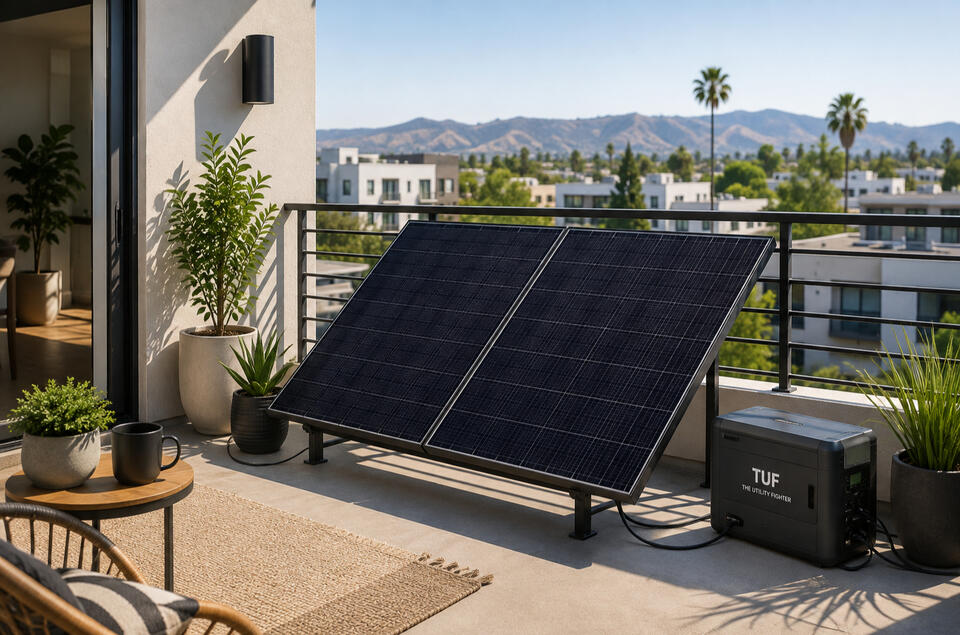
Plug-in solar lets you generate your own electricity from a balcony, patio, backyard, or other sunny space—without a traditional rooftop solar project. TUF is building simple balcony solar and portable solar options for everyday homes.
PLUG-IN SOLAR, SIMPLIFIED
Solar shouldn’t require a construction project.
Traditional rooftop solar can mean permits, contractors, financing, and weeks of planning. Plug-in solar—sometimes called balcony solar—is designed to be different: a small, certified solar system that lets you generate electricity from the sunny space you already have.
01
Put it in the sun
Place the panels on a balcony, patio, backyard, or other sunny space.
02
Plug it in
Connect the certified system according to the manufacturer’s instructions.
03
Use your solar
Your home uses the solar electricity first, reducing how much power you buy from the utility.
BUILT FOR MORE PEOPLE
Solar for people traditional rooftop solar leaves out.
Apartment & Renters
No roof ownership? Balcony solar and other qualifying plug-in solar systems could give renters a way to generate some of their own electricity from a balcony or patio.
Condos & Townhomes
Own your home but not the roof? Small plug-in solar systems can create another option when traditional rooftop solar is impractical.
Homeowners
Want solar without a full rooftop project? Start smaller with a system designed for patios, yards, balconies, and other sunny spaces.
TUF SYSTEMS
Simple plug-in solar for everyday spaces.
TUF is developing simple plug-in solar options for different spaces, energy needs, and state requirements. Final system configurations will depend on certified products and local rules.
TUF 400
For small spaces
Designed as an entry-level plug-in solar option for balconies, patios, and smaller energy needs.
COMING SOON
TUF 800
Everyday plug in solar
A larger system for customers who want more daily production without moving into a traditional rooftop project.
COMING SOON
TUF 1200
Maximum-output option
Designed around the highest-output plug-in configurations allowed where state rules and certified products permit.
COMING SOON
TUF + Storage
Solar after sunset
A plug-in solar system paired with compatible battery storage so more of your solar energy can be used later in the day.
COMING SOON
PLUG-IN SOLAR ACROSS AMERICA
Where is plug-in solar legal?
State-by-state laws and pending legislation.
States across the U.S. are creating new rules for small plug-in solar and portable solar generation systems. Some have already enacted laws, while others are moving legislation forward. TUF tracks these changes so customers can understand where qualifying systems can be used and what requirements may apply.
Plug-in solar laws by state — last updated August 2026
PASSED LEGISLATURE
State requirements and effective dates vary. TUF will keep this list updated as laws and regulations change.
CALIFORNIA IS GETTING READY
California Plug-In Solar & Balcony Solar: SB 868
California’s SB 868 has passed both houses of the Legislature and is awaiting action by the Governor. If enacted, the Plug and Play Solar Act would establish a statewide framework for qualifying plug-in solar and balcony solar systems with up to 1,200 watts of AC output per dwelling.
Status: Passed Legislature — awaiting Governor’s action
Bill: SB 868
Effective date: January 1, 2027, if enacted
System limit: Up to 1,200 watts AC per dwelling
Utility approval: Not required for qualifying systems
Utility notification: May be requiredCalifornia utilities would not be allowed to require an interconnection agreement, advance approval, a fee related to the device, or additional controls beyond those incorporated into the qualifying system. A utility could require the customer to complete a simple online notification providing the address, make, model, and size of the system, but that notification could not be used as an approval process.Important: SB 868 has passed the California Legislature and was presented to Governor Newsom on August 31, 2026. It is currently awaiting the Governor’s action. Qualifying systems would be limited to 1,200 watts of aggregate AC output per dwelling, connect through a receptacle, meet applicable electrical-code requirements, be certified as a plug-in photovoltaic system by UL or an equivalent nationally recognized testing laboratory, and include certified anti-islanding protection. If enacted, the streamlined utility interconnection provisions would remain in effect through December 31, 2029, with additional product-sale safety requirements beginning January 1, 2030.
COLORADO
Colorado Plug-In Solar: What the New Law Allows
Colorado has enacted a statewide plug-in solar law covering qualifying portable solar generation systems. Qualifying systems can supply up to 1,920 watts to the electric grid and must be listed by a nationally recognized testing laboratory. The law also requires protection that prevents the system from energizing the grid during a power outage.
Status: Law enacted
Bill: HB 26-1007
Effective date: August 12, 2026
System limit: Up to 1,920 watts
Utility approval: Not required for qualifying systems
Utility notification: May be requiredColorado utilities cannot require advance approval, charge a fee related to the device, or require additional controls beyond those incorporated into the UL-listed system. A utility may require the customer to notify it that the device is present and provide its size.Important: Colorado’s plug-in solar law took effect August 12, 2026. Additional protections for homeowners in HOAs and common-interest communities take effect January 1, 2027. Reasonable safety, mounting, and property restrictions may still apply.
CONNECTICUT
Connecticut Plug-In Solar: Legal Beginning October 1, 2026
Connecticut has enacted a plug-in solar framework for qualifying portable solar generation devices beginning October 1, 2026. Systems can have a maximum output of 1,200 watts, connect through a standard 120V outlet behind the customer’s meter, and must meet applicable electrical and safety standards. The law was signed by the Governor on June 4, 2026 and the portable-solar provisions take effect October 1, 2026.
Status: Law enacted
Law: Public Act 26-127 / HB 5340
Effective date: October 1, 2026
System limit: Up to 1,200 watts
Connection: Standard 120V AC outlet
Interconnection: Qualifying systems exempt from standard interconnection agreements
Utility approval: Not required
Limit: One qualifying device per electric meterConnecticut utilities may not require advance approval, charge a system-related fee, or require additional controls beyond those already integrated into a compliant device. Qualifying equipment must also include anti-islanding protection so it cannot energize the building during an outage.Important: Connecticut requires qualifying portable solar devices to not be permanently affixed to a structure, and applicable state building, fire, and local rules still apply. The law also requires a consumer warning that excess generation may be charged as electricity usage unless the customer has a meter that supports net metering.
MAINE
Maine Plug-In Solar: Rules for Portable Solar Systems
Maine allows qualifying plug-in solar and portable photovoltaic systems under a statewide framework with different requirements based on system size. The law allows eligible systems to connect through a standard electrical outlet and exempts qualifying systems from the traditional utility interconnection process. It was signed April 6, 2026 and took effect July 29, 2026.
Status: Law enacted
Law: Public Law Chapter 644 / LD 1730
Effective date: July 29, 2026
System limit: Up to 1,200 watts
Utility approval: Not required
Interconnection: Qualifying systems exempt from standard interconnection requirements
Net metering: Not permitted for these systemsImportant: Maine has a two-tier setup. Systems up to 420 watts AC can be installed without the additional requirements that apply to larger systems. Systems over 420 watts and up to 1,200 watts must be installed by a Maine-licensed electrician, use a dedicated circuit with a single outlet, and be reported to the utility within 30 days of installation.
MARYLAND
Maryland Plug-In Solar: Rules for Portable Solar Systems
Maryland has enacted a statewide framework allowing qualifying residential plug-in solar and portable solar generation systems.. Residential customers may install one qualifying system per electric meter, with up to 1,200 watts of power supplied back to the building’s electrical system. Qualifying systems connect through a standard electrical outlet and must meet applicable safety-certification requirements.
Status: Law enacted and in effect
Law: Chapter 353 / HB 1532
Effective date: May 12, 2026
System limit: Up to 1,200 watts
Use: Residential only
Limit: One qualifying system per electric meter
Utility approval: Not required
Utility fee: Not permitted
Utility notification: Required before installationImportant: Maryland does not require advance utility approval, but customers must notify their electric company before installation and provide certification of the system’s safety features and maximum generating capacity. If the system requires an automatic locking disconnect switch, the customer is responsible for the cost of that installation.Systems with a maximum output of 391 watts or less also receive an additional exemption from product-listing provisions that would otherwise require alterations to the building’s wiring, electrical panel, or premises.
NEW HAMPSHIRE
New Hampshire Plug-In Solar: Law Takes Effect January 1, 2027
New Hampshire has enacted a plug-in solar law that creates a simplified pathway for qualifying systems beginning January 1, 2027. The law allows compliant systems to connect to a building through a receptacle or other non-permanent wiring connection and eliminates the traditional utility approval and interconnection process for qualifying systems.
Status: Law enacted
Law: Chapter 262 / SB 540
Effective date: January 1, 2027
System limit: Up to 1,200 watts AC inverter output
Limit: One qualifying system per metered customer
Utility approval: Not required
Interconnection review: Not required
Utility fee: Not permitted
Utility notification: May be required after installationImportant: Qualifying systems must be certified by a nationally recognized testing laboratory and comply with applicable national safety standards. Systems must also be installed and operated according to manufacturer instructions and applicable state building-code requirements. Utilities may create a process for customers to report the system wattage after installation, but that notification cannot be used as an approval or interconnection requirement.
UTAH
Utah Plug-In Solar: What the State Law Allows
Utah was one of the first states to establish a dedicated legal framework for qualifying plug-in solar and portable solar generation devices. Qualifying systems are exempt from the traditional interconnection process required for larger solar installations, provided they meet the law’s safety requirements.
Status: Law enacted
Bill: HB 340
System limit: Up to 1,200 watts
Interconnection: Qualifying systems exempt from standard interconnection requirementsUtah’s legislative materials specifically describe HB 340 as creating the portable-solar category and exempting qualifying systems from items such as interconnection agreements, inspections, testing, and metering requirements.
VERMONT
Vermont Plug-In Solar: Rules, Limits & Requirements
Vermont has enacted a statewide framework for qualifying plug-in photovoltaic and balcony solar systems. Customers may install one or more qualifying devices per electric meter as long as their combined inverter capacity does not exceed 1,200 watts. Systems must use a smart meter, meet applicable safety-certification requirements, and be temporarily but securely attached to the ground or a structure.
Status: Law enacted and in effect
Law: Act 149 / S.202
Effective date: July 1, 2026
System limit: Up to 1,200 watts combined inverter capacity
Utility approval: Not required
Interconnection agreement: Not required
Utility fee: Not permitted
Smart meter: Required
Net metering: Not permittedImportant: Plug-in solar systems in Vermont are not eligible for net metering, and electricity exported to the grid is not compensated. Customers who already have a net-metered solar system may not also install a qualifying plug-in photovoltaic device.Renters must give their landlord at least 10 days’ notice before installation. The landlord may impose reasonable installation requirements, including requirements related to electrical work, but if the landlord does not respond within 10 days, the tenant may proceed as allowed by the law.
VIRGINIA
Virginia Plug-In Solar: Law Takes Effect January 1, 2027
Virginia has enacted legislation allowing qualifying plug-in solar and portable solar generation devices beginning January 1, 2027. Qualifying systems may have up to 1,200 watts of output and connect to a building through an electrical outlet without going through the traditional utility interconnection process.
Status: Law enacted
Laws: Chapters 377 & 378 / HB 395 & SB 250
Effective date: January 1, 2027
System limit: Up to 1,200 watts
Utility approval: Not required
Interconnection agreement: Not required
Utility fee: Not permitted
Utility notification: Required before installation
Utility review period: Up to 15 daysImportant: Virginia requires customers to submit a simple notification form to their electric utility before installing a qualifying system. The utility has 15 days to review the form for accuracy and completeness. If the utility does not respond within that period, the notification requirement is considered satisfied and the customer may proceed with installation.Qualifying systems must meet applicable electrical standards, be certified by a nationally recognized testing laboratory, and include protection that prevents the system from energizing the grid or building electrical system during an outage. Systems supplying no more than 391 watts to the receptacle receive an additional exemption from certain product-listing provisions that would otherwise require alterations to the building’s wiring, electrical panel, or premises.Virginia also includes renter protections. Certain landlords with more than four rental units generally may not prohibit a qualifying device on the exterior of a tenant’s premises, although reasonable restrictions on size, location, and placement are allowed. Tenants must provide at least seven days’ notice before installation.
NEW YORK
New York Balcony Solar: SUNNY Act Status
New York’s Solar Up Now New York (SUNNY) Act would establish a statewide framework for qualifying plug-in solar and balcony solar systems. The bill has passed both houses of the New York Legislature and, if signed into law, would take effect 90 days later.
Status: Passed Legislature — awaiting Governor action
Bill: SUNNY Act / A.9111C / S.8512C
Effective date: 90 days after becoming law
System limit: Up to 1,200 watts aggregate continuous AC inverter output
Connection: Standard electrical outlet
Utility approval: Not required
Interconnection agreement: Not required unless voluntarily requested
Utility fee: Not permitted
Utility notification: Required within 30 days after installation
Export compensation: None unless customer voluntarily enters a compensation agreementImportant: The legislation requires qualifying systems to be certified by an accredited nationally recognized testing laboratory as a complete plug-in photovoltaic system and to include protection preventing the system from energizing the building or electric grid during an outage.Customers would not need advance utility approval. However, within 30 days after installation, the owner would need to submit a simple utility notification containing customer information, service address and account number, device make and model, and rated system size.Electricity exported to the grid would normally be uncompensated. Customers could voluntarily enter into a net-metering or other compensation agreement if available.
NEW JERSEY
New Jersey Balcony Solar: Garden State Balcony Solar Act Status
New Jersey’s Garden State Balcony Solar Act would establish a statewide framework for qualifying plug-in solar and portable solar generation systems. If enacted, the bill would apply to qualifying systems with up to 1,200 watts of combined output.Eligible systems would connect through a standard 120-volt outlet, operate on the customer’s side of the electric meter, and meet applicable safety and anti-islanding requirements for plug-in photovoltaic systems.
Status: Law enacted
Bill: Garden State Balcony Solar Act / S2368 / A4836
Signed: September 1, 2026
Effective date: March 1, 2027
System limit: Up to 1,200 watts combined output per service address or dwelling unit
Connection: Standard 120V AC outlet
Utility approval: Not required for qualifying systems
Interconnection agreement: Not required for qualifying systems
Utility fee: Not permitted
Net metering: Qualifying systems are exempt from net-metering requirements
Small-system threshold: 400 wattsImportant: New Jersey’s Garden State Balcony Solar Act was signed into law on September 1, 2026, and takes effect March 1, 2027. Qualifying systems must meet applicable electrical and product-safety requirements, connect through a standard 120V AC outlet, operate on the customer’s side of the electric meter, and include protection that prevents the system from energizing the utility grid during an outage. Systems with a maximum output of 400 watts or less receive an additional exemption from provisions that would otherwise require alterations to a building’s wiring, electrical panel, or premises. Larger qualifying systems, up to the 1,200-watt limit, must still comply with applicable product-listing, electrical-code, and building-code requirements.The law also includes protections for renters and residents of condominiums and HOA-governed communities. A qualifying tenant generally must provide written notice at least 14 days before placing or using a system. Landlords, condominium associations, and HOAs may impose reasonable restrictions related to size, placement, safety, and installation, but generally may not prohibit qualifying systems outright.
BE FIRST IN LINE
Ready to get TUF?
Join the launch list for product updates, state-law changes, and early access when TUF systems become available.
QUESTIONS, ANSWERED
Plug-in solar, without the confusion.
What is plug-in solar?
Plug-in solar is a small photovoltaic system designed to generate electricity for use inside your home without a traditional rooftop solar installation. These systems are sometimes called balcony solar or portable solar generation systems. Qualifying systems connect according to specific product and state requirements.
Is plug-in solar legal where I live?
It depends on your state. Several states have already enacted plug-in solar laws, while others are considering legislation. TUF tracks these changes and will only offer systems where and when applicable requirements can be met.
How much power can a plug-in solar system produce?
System limits vary by state and product. TUF plans to offer different system sizes so customers can choose an option that fits their available space, electricity use, and local requirements.
Can renters use plug-in solar?
Potentially. Plug-in solar can make solar accessible to renters, but lease terms, landlord approval, HOA rules, mounting restrictions, and state requirements may still apply.
Will it work during a power outage?
Not necessarily. Standard grid-connected solar systems generally shut down during an outage for safety. Systems with compatible battery storage may offer additional backup capabilities depending on their design.
Can I add a battery?
Yes. Compatible battery storage can allow you to save solar energy for later use rather than using all of it as it is produced. TUF plans to offer solar-plus-storage options as compatible products become available.

Make power. Buy less.
© 2026 The Utility Fighter. All rights reserved.

Privacy Policy
Last updated: August 19, 2026
The Utility Fighter (“TUF,” “we,” “us,” or “our”) respects your privacy. This Privacy Policy explains how we collect, use, disclose, and protect information when you visit TheUtilityFighter.com, join our launch list, contact us, or otherwise interact with our website.Information We CollectWhen you voluntarily provide information through our website, we may collect:- Your name
- Email address
- ZIP code
- State
- Information you choose to provide about your interest in plug-in solar, battery storage, or related products and services
- Your consent to receive TUF email communicationsWe and our service providers may also automatically collect limited technical information when you visit the site, such as your IP address, browser type, device information, referring website, pages visited, and marketing or UTM parameters associated with your visit.How We Use Your InformationWe may use the information we collect to:- Maintain and manage the TUF launch list
- Send product announcements, launch information, legislative updates, and other communications you have requested
- Respond to questions, inquiries, or support requests
- Understand where interest in plug-in solar and related products is developing
- Improve our website, products, services, and customer experience
- Measure website traffic and understand how visitors use the site
- Protect the security and integrity of our website
- Comply with applicable laws and legal obligationsEmail CommunicationsIf you join the TUF launch list or otherwise consent to receive email communications from us, we may send you information about plug-in solar, battery storage, product availability, changing state laws, TUF news, and related topics.You may unsubscribe from marketing emails at any time by using the unsubscribe method provided in our communications or by contacting us directly.How We Share InformationTUF does not sell your personal information.We may share information with trusted service providers that help us operate our website and business. These may include website hosting providers, email providers, analytics providers, customer-management services, security providers, and other technology vendors.These service providers may process information only as necessary to provide services to us and are subject to their own privacy and security practices.We may also disclose information when required by law, legal process, government request, or when reasonably necessary to protect TUF, our customers, our rights, or the security of our services.Website and Third-Party ServicesTheUtilityFighter.com currently uses third-party services, including Carrd and Cloudflare, to operate and deliver portions of the website.These services may process limited technical information associated with your visit according to their own privacy policies and terms.Our website may also contain links to third-party websites. TUF is not responsible for the privacy practices, security, accuracy, or content of third-party websites.Cookies and Similar TechnologiesTUF and our service providers may use cookies or similar technologies necessary for website functionality, security, traffic measurement, and understanding how visitors interact with the website.If we introduce additional analytics, advertising, e-commerce, or tracking technologies in the future, we may update this Privacy Policy and provide additional disclosures where required.Data RetentionWe retain personal information for only as long as reasonably necessary for the purposes described in this Privacy Policy.This may include maintaining our launch list, providing requested communications, responding to inquiries, complying with legal obligations, resolving disputes, and protecting our business.You may request deletion of information you have provided to us, subject to any information we are legally permitted or required to retain.Your Privacy ChoicesDepending on where you live and the laws that apply to you, you may have rights regarding your personal information, including the ability to request access to, correction of, or deletion of certain personal information.You may also opt out of TUF marketing communications at any time.To submit a privacy-related request, contact us using the information below.California ResidentsCalifornia residents may have additional privacy rights under applicable California law.Depending on the circumstances and whether those laws apply to TUF, these rights may include the ability to request information about personal information collected, request correction or deletion, and obtain information regarding how personal information is used or disclosed.TUF does not sell personal information.Children’s PrivacyThe Utility Fighter website and services are not directed to children under 13, and we do not knowingly collect personal information from children under 13.If we learn that we have collected personal information from a child under 13, we will take reasonable steps to delete that information.SecurityWe use reasonable administrative and technical measures intended to protect information submitted through our website.However, no website, internet transmission, or electronic storage system can be guaranteed to be completely secure. You provide information through the internet at your own risk.Changes to This Privacy PolicyWe may update this Privacy Policy as TUF grows, our website changes, new products or services are introduced, or privacy requirements change.When changes are made, we will update the “Last updated” date displayed at the top of this page.Contact UsIf you have questions about this Privacy Policy or would like to make a privacy-related request, contact:The Utility Fighter (TUF)
TheUtilityFighter.com
Email: [email protected]
Legal Disclaimer
Last updated: August 19, 2026
The information provided by The Utility Fighter (“TUF,” “we,” “us,” or “our”) on TheUtilityFighter.com is provided for general informational and educational purposes only.TUF provides information about plug-in solar, balcony solar, portable solar generation, battery storage, energy products, utility programs, legislation, regulations, and related topics. Laws, regulations, utility requirements, electrical codes, building codes, product standards, and other requirements can vary by location and may change at any time.Not Legal or Professional AdviceNothing on TheUtilityFighter.com should be considered legal, electrical, engineering, tax, financial, permitting, code-compliance, or other professional advice.Information published by TUF is intended to help consumers better understand plug-in solar and related technologies. Customers should independently verify requirements that apply to their specific property, equipment, utility, and jurisdiction before purchasing, installing, connecting, or operating any system.If you need advice regarding your specific circumstances, consult an appropriately qualified professional.State Laws and RegulationsTUF publishes summaries of plug-in solar legislation and regulations in various U.S. states.We make reasonable efforts to provide accurate and current information, but laws and regulations can change quickly. Legislation may be amended, delayed, vetoed, replaced, repealed, interpreted differently by regulators, or subject to additional rules that have not yet been adopted.A state being identified on TheUtilityFighter.com as having enacted or pending plug-in solar legislation does not necessarily mean that every plug-in solar system may legally be installed or used at every property within that state.State summaries are not intended to reproduce every requirement, exception, definition, effective date, local ordinance, or regulatory condition that may apply.Customers should confirm current requirements before purchasing or installing equipment.Product Eligibility and ComplianceA product being displayed, discussed, recommended, or sold on TheUtilityFighter.com does not, by itself, mean that the product is approved, certified, legal, or appropriate for use in every state, utility territory, municipality, building, or property.Different jurisdictions may have different requirements related to:- Maximum system output
- Electrical connections
- Product certification
- Nationally recognized testing laboratory listings
- Anti-islanding protection
- Dedicated circuits
- Electrical outlets or receptacles
- Utility notification
- Utility registration
- Interconnection
- Building permits
- Electrical permits
- Fire codes
- Mounting methods
- Structural requirements
- Battery storage
- Landlord approval
- HOA or condominium rules
- Local zoning or property restrictionsCustomers are responsible for determining whether a particular product and installation method are permitted at their location.Electrical and Installation SafetySolar generation and battery equipment involves electricity and must be installed, connected, operated, and maintained safely.All products should be used only in accordance with manufacturer instructions, applicable product certifications, electrical codes, building codes, fire codes, and other applicable safety requirements.Some jurisdictions may require installation or electrical work to be performed by a licensed electrician or other qualified professional.TUF does not recommend modifying electrical wiring, panels, receptacles, circuits, solar equipment, batteries, or other electrical components in a manner that conflicts with manufacturer instructions or applicable law.Utilities and Interconnection RequirementsSome plug-in solar laws eliminate traditional utility interconnection approval for qualifying systems. Others may still require notification, registration, equipment information, customer information, or other documentation.Utility policies may also change as states implement new plug-in solar laws.Customers are responsible for satisfying any utility notification, registration, metering, interconnection, or other requirements that apply to their system.TUF cannot guarantee that a utility will interpret or implement a law in a particular way.Renters, Condominiums, and HOAsState plug-in solar laws may provide certain protections for renters, condominium owners, or residents of HOA-governed communities. These protections vary significantly by state.Lease agreements, landlord requirements, condominium rules, HOA restrictions, property-management rules, structural limitations, and local codes may still apply.Customers who do not own the property where equipment will be placed should confirm their rights and responsibilities before installing or attaching equipment.Product InformationProduct specifications, certifications, warranties, compatibility, availability, pricing, and other information may be provided by manufacturers, distributors, or other third parties.TUF makes reasonable efforts to present accurate product information but does not guarantee that third-party information is complete, current, or error-free.Manufacturers may modify products, specifications, certifications, warranties, software, or installation requirements without notice.Customers should review current manufacturer documentation before purchasing or using any product.Energy Production and Savings EstimatesAny electricity-production, utility-bill savings, payback-period, energy-cost, battery-performance, or similar estimates shown on TheUtilityFighter.com are estimates only.Actual results may vary significantly based on factors including:- Geographic location
- Weather
- Shade
- Panel orientation
- Panel angle
- System size
- Equipment efficiency
- Household electricity consumption
- Time of electricity use
- Utility rates
- Rate-plan changes
- Battery operation
- Equipment degradation
- Local regulations
- Export rulesTUF does not guarantee any specific level of electricity production, utility-bill reduction, financial savings, payback period, or investment return.Power Outages and Backup PowerStandard grid-connected solar equipment may be designed to stop supplying electricity during a utility outage for safety reasons.The presence of solar panels does not necessarily mean that electricity will be available during an outage.Backup capabilities depend on the specific equipment, battery system, electrical configuration, product certifications, and installation.Customers should review manufacturer specifications before relying on any system for emergency or backup power.Third-Party Websites and ServicesTheUtilityFighter.com may include links to manufacturers, utilities, government agencies, retailers, service providers, and other third-party websites.These links are provided for convenience and informational purposes.TUF does not control and is not responsible for the content, accuracy, availability, security, products, services, privacy practices, or policies of third-party websites.No Guarantee of AvailabilityProducts, services, pricing, launch dates, certifications, state eligibility, and other offerings displayed on TheUtilityFighter.com may change without notice.Products labeled “Coming Soon,” “Planned,” or similar language may be changed, delayed, replaced, or never offered.No WarrantiesTo the fullest extent permitted by applicable law, information provided on TheUtilityFighter.com is provided on an “as is” and “as available” basis without warranties regarding completeness, accuracy, reliability, availability, or suitability for a particular purpose.Nothing in this disclaimer limits any rights or warranties that cannot legally be excluded or limited.Limitation of LiabilityTo the fullest extent permitted by applicable law, TUF will not be responsible for losses or damages arising solely from reliance on general informational content published on TheUtilityFighter.com.Customers remain responsible for verifying requirements applicable to their property and for following manufacturer instructions, applicable laws, utility requirements, and safety standards.Nothing in this disclaimer limits liability or consumer rights that cannot legally be limited under applicable law.Changes to This DisclaimerTUF may update this Legal Disclaimer as laws, regulations, products, services, or website features change.The “Last updated” date at the top of this page will identify the most recent revision.Contact UsQuestions regarding information published on TheUtilityFighter.com may be directed to:The Utility Fighter (TUF)
TheUtilityFighter.com
Email: [email protected]

Terms of Use
Last updated: August 19, 2026
These Terms of Use (“Terms”) govern your use of TheUtilityFighter.com and the information, features, forms, and services provided through the website by The Utility Fighter (“TUF,” “we,” “us,” or “our”).
By accessing or using TheUtilityFighter.com, you agree to these Terms. If you do not agree with these Terms, please do not use the website.
Use of the Website
TheUtilityFighter.com is currently provided primarily for informational, educational, and prelaunch purposes.
The website may provide information about plug-in solar, balcony solar, portable photovoltaic systems, battery storage, utility programs, state legislation, regulations, proposed products, and related energy topics.
You may use the website only for lawful purposes and in accordance with these Terms.
Informational Content
Information provided on TheUtilityFighter.com is intended for general informational and educational purposes only.
TUF makes reasonable efforts to provide accurate and current information, but we do not guarantee that all information is complete, current, or applicable to every location or circumstance.
Laws, utility requirements, product standards, electrical codes, building codes, and other requirements may change.
Use of this website does not create a contractor, engineering, legal, financial, tax, or other professional relationship between you and TUF.
Please review our Legal Disclaimer for additional information.
State Law Information
TheUtilityFighter.com may provide summaries of enacted, pending, or proposed plug-in solar laws in various states.
These summaries are provided for convenience and general informational purposes only.
A state being identified as having enacted or pending plug-in solar legislation does not guarantee that a particular product, installation, property, customer, or use qualifies under that law.
Users are responsible for confirming current requirements that apply to their location before purchasing, installing, connecting, or operating equipment.
Launch List and Email Communications
You may voluntarily provide information to join the TUF launch list or receive updates.
If you submit the launch-list form and provide consent, you agree that TUF may send you information about product development, product availability, plug-in solar, battery storage, changes in state laws, TUF announcements, and related topics.
You may unsubscribe from marketing communications at any time.
Joining the launch list does not create a purchase agreement, product reservation, guarantee of availability, or obligation to purchase anything.
Products and Coming Soon Information
TUF may display proposed or future product categories such as TUF 400, TUF 800, TUF 1200, solar-plus-storage systems, or other products.
Products identified as “Coming Soon,” planned, proposed, or otherwise not currently available may be changed, renamed, delayed, replaced, or discontinued.
Prelaunch product descriptions should not be interpreted as final specifications, certifications, pricing, warranties, or availability.
A product being displayed or discussed on TheUtilityFighter.com does not mean that it is approved, certified, legal, or appropriate for use in every state, utility territory, municipality, building, or property.
If TUF begins selling products, additional purchase, payment, shipping, return, warranty, and transaction terms may apply.
Intellectual Property
Unless otherwise stated, the TUF name, The Utility Fighter name, logos, branding, original graphics, website design, written content, product names, and other original materials appearing on TheUtilityFighter.com are owned by or licensed to TUF and may be protected by applicable intellectual-property laws.
You may view and use website content for your own personal, noncommercial informational purposes.
You may not reproduce, republish, distribute, sell, modify, or commercially exploit TUF content or branding without permission, except where permitted by law.
Third-Party Websites and Services
TheUtilityFighter.com may contain links to manufacturers, utilities, government agencies, retailers, regulatory agencies, and other third-party websites or services.
These links are provided for convenience and informational purposes.
TUF does not control and is not responsible for the content, accuracy, security, availability, products, services, privacy practices, or policies of third-party websites.
Your use of third-party websites is subject to their own terms and policies.
Information You Submit
If you submit information through TheUtilityFighter.com, you represent that the information you provide is accurate to the best of your knowledge and that you have the right to provide it.
Personal information submitted through the website will be handled in accordance with our Privacy Policy.
Please do not submit passwords, Social Security numbers, financial-account information, or other highly sensitive information through general website forms.
Website Availability
TUF may modify, update, suspend, restrict, or discontinue any part of TheUtilityFighter.com at any time.
We do not guarantee that the website will always be available, uninterrupted, secure, or error-free.
No Warranties
To the fullest extent permitted by applicable law, TheUtilityFighter.com and its informational content are provided on an “as is” and “as available” basis.
TUF does not guarantee the accuracy, completeness, reliability, availability, or suitability of website content for any particular purpose.
Nothing in these Terms excludes warranties or consumer protections that cannot legally be excluded.
Limitation of Liability
To the fullest extent permitted by applicable law, TUF will not be responsible for indirect, incidental, special, or consequential losses arising solely from reliance on general informational content provided through TheUtilityFighter.com.
Users remain responsible for independently verifying information and determining whether a product, installation, or action is appropriate for their particular circumstances.
Nothing in these Terms limits liability or consumer rights that cannot legally be limited.
Privacy
Your use of TheUtilityFighter.com is also subject to our Privacy Policy.
The Privacy Policy explains how TUF may collect, use, disclose, and protect personal information submitted through the website.
Legal Disclaimer
Your use of TheUtilityFighter.com is also subject to our Legal Disclaimer.
The Legal Disclaimer contains important information regarding state-law summaries, utility requirements, product eligibility, electrical safety, installation requirements, and energy-production or savings estimates.
Changes to These Terms
TUF may update these Terms as the website changes, new products or services are introduced, or legal requirements change.
When these Terms are revised, the “Last updated” date at the top of this page will be updated.
Contact Us
Questions regarding these Terms may be directed to:
The Utility Fighter (TUF)
TheUtilityFighter.com
Email: [email protected]

GET IN TOUCH
Questions? We’d like to hear from you.
Questions about plug-in solar, state availability, future TUF products, or anything else? Reach out anytime.General inquiries
[email protected]For product availability and state-law updates, join the TUF launch list.